Curtis T. McMullen 1998 Fields Medalist Curtis T. McMullen
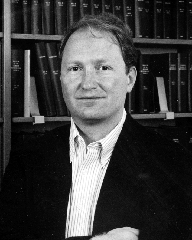
Curtis T. McMullen has been awarded a medal primarily in recognition of hiswork in the fields of geometry and "complex dynamics," a branch of thetheory of dynamic systems, better known perhaps as chaos theory. McMullenhas made contributions in numerous fields of mathematics and fringeareas. He already provided one important result in his doctoral thesis.The question was how to calculate all the solutions of an arbitrary equation.For simple equations it is possible to obtain the solutions by simplerearrangement. For most equations, however it is necessary to useapproximation. One well-known form is "Newton's method" -already known ina rudimentary form in ancient times. For second-degree polynomials thisprovides very good results without exception. A key question thereforewas whether a comparable method - which happened not to have been discovered - also existed for equations of higher degrees. Curtis T.McCullen's conclusion was that there is definitely no such universalalgorithm for equations above degree three; only a partially applicablemethod is possible. For degree-three equations he developed a "new"Newtonian method and could thus completely solve the question of approximation solutions.
A further result of McMullen relates to the Mandelbrot set. This setdescribes dynamic systems which can be used to model complicated naturalphenomena such as weather or fluid flow. The point of interest is wherea system drifts apart and which points move towards centers of equilibrium.The border between these two extremes is the so-called Julia set, namedafter the French mathematician Gaston Julia, who laid the foundationsfor the theory of dynamic systems early in the twentieth century.The Mandelbrot set shows the parametersfor which the Julia set is connected, i.e. is mathematically attractive.This description is very crude, but a better characteristic of theboundary set was not available. Curtis T. McMullen made a major advance,however, when he showed that it is possible to decide in part on the basis of the Mandelbrot set which associated dynamic system is "hyperbolic"and can therefore be described in more detail. For these systemsa well-developed theory is available. McMullen's results were suspectedalready in the sixties, but nobody had previously been able to provethis exact characterization of the Julia set.
Curtis T. McMullen (born 21 May 1958) is visiting professor atHarvard University. He studied in Williamstown, Cambridge Universityand Paris before gaining a doctorate in 1985 at Harvard. He lecturedat various universities before becoming professor at the Universityof California in Berkeley. Since 1998 he has taught at Harvard. TheFields Medal is his tenth major award. In 1998 he has been elected tothe American Academy of Arts and Sciences.
Welcome to the
Feature Column!
These web essays are designed for those who have already discovered the joys of mathematics as well as for those who may be uncomfortable with mathematics.
Read more . . .
Feature Column at a glance