When Kissing Involves Trigonometry
Posted March 2006.
For pairs of lips to kiss maybe
Involves no trigonometry...
David Austin
Grand Valley State University
david at merganser.math.gvsu.edu 
The Descartes Circle Theorem
In a 1643 letter to Princess Elizabeth of Bohemia, René Descartes described an elegant relationship, now known as the Descartes Circle Theorem, between the radii of four mutually tangent circles, such as those shown below.
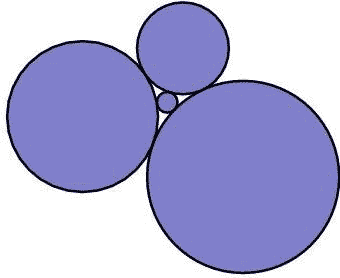
The Descartes Circle Theorem is most succintly expressed using the curvatures, i.e. the reciprocals of the radii, of the circles: denoting the curvatures by  , we have
![\[ b_1^2+b_2^2+b_3^2+b_4^2 = \frac12(b_1+b_2+b_3+b_4)^2. \]](/featurecolumn/images/march2006/index_2.gif)
We call a collection of four mutually tangent circles a Descartes configuration.
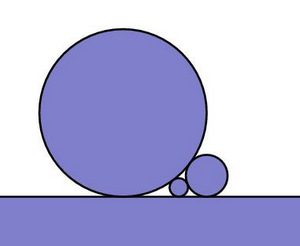
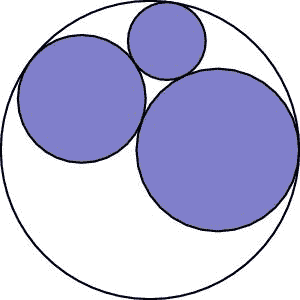
Descartes' relationship also applies to configurations, such as those shown below, that may seem exceptional. On the left, we view straight lines as having zero curvature, while the curvature of the outer circle on the right is taken to be negative. With these conventions, Descartes' relationship is still valid.
This theorem has been discovered independently several times. For instance, it was known in eighteenth century Japan (see Tony Rothman's article cited in the references). Frederick Soddy, a chemist who won the Nobel Prize in 1921 for his discovery of isotopes, also found a proof of it and was so pleased with the theorem that he published it in the form of a poem entitled The Kiss Precise. The poem begins with these lines:
For pairs of lips to kiss maybe
Involves no trigonometry.
'Tis not so when four circles kiss
Each one the other three.
In a third verse, Soddy describes a similar result for five mutually tangent spheres: the sum of the squares of the curvatures is one third the square of the sum of the curvature:
![\[ b_1^2+b_2^2+b_3^2+b_4^2+b_5^2 = \frac13(b_1+b_2+b_3+b_4+b_5)^2. \]](/featurecolumn/images/march2006/index_3.gif)
The next year, Thorold Gosset added a fourth verse describing the relationship between the curvatures of  mutually tangent
  -dimensional spheres:
![\[ b_1^2+b_2^2+\ldots+b_{n+2}^2 = \frac1n(b_1+b_2+\ldots+b_{n+2})^2. \]](/featurecolumn/images/march2006/index_6.gif)
Swapping Descartes configurations
If we begin with three mutually tangent circles, shown in black below, there are two ways of adding circles, shown in red, to create Descartes configurations.
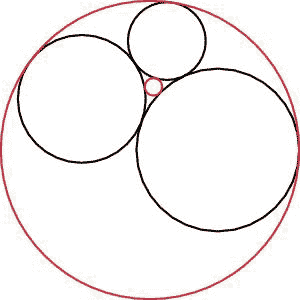
A relationship between the curvatures of these two circles may be determined from the Circle Theorem. We will call the curvature of the first three circles  , and
, and  , and the curvature of a fourth circle in a Descartes configuration
  . We then have
![\[ b_1^2+b_2^2+b_3^2+x^2 = \frac12(b_1+b_2+b_3+x)^2 \]](/featurecolumn/images/march2006/index_10.gif)
giving a quadratic equation for  :
:
![\[ x^2-2(b_1+b_2+b_3)x+(b_1^2+b_2^2+b_3^2)-(b_1b_2+b_1b_3+b_2b_3)=0. \]](/featurecolumn/images/march2006/index_12.gif)
If we call the two solutions  and
and  , we find that
![\[ \begin{array}{rl} b_4+b_4' & = 2b_1+2b_2+2b_3 \\ b_4' & = 2b_1+2b_2+2b_3 -b_4 \end{array} \]](/featurecolumn/images/march2006/index_15.gif)
In particular, this gives us a simple way to produce new Descartes configurations. Beginning with one configuration, we may delete one of the circles, whose curvature we call  , and replace it with a new circle whose curvature is
  .
.
To illustrate with an example, we will begin with the Descartes configuration, shown on the left below, whose curvatures are  and replace the circle whose curvature is
  . The curvature of the new circle is
  , and the resulting configuration is shown on the right.
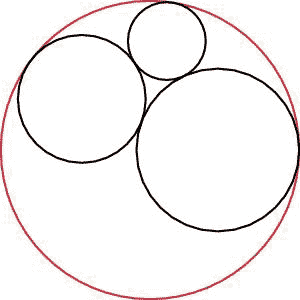
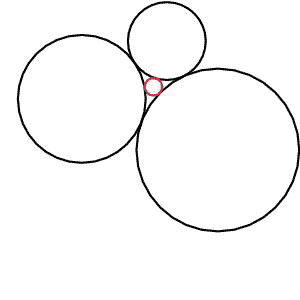
This example illustrates another remarkable fact that was also noticed by Soddy: if the four curvatures in a configuration are integers, then the curvatures in the new configuration are also integers due to the fact that  .
.
While the curvatures of the two circles that are swapped are simply related, the circles themselves are also simply related through inversion in a circle. To describe this process, let's begin with a circle centered at the point  . Inverting in this circle is much like reflecting in a line: we send a point
  to a point
  in such a way that the points
  , and
, and  are collinear, and the product of the distances
  equals the square of the radius of the circle.
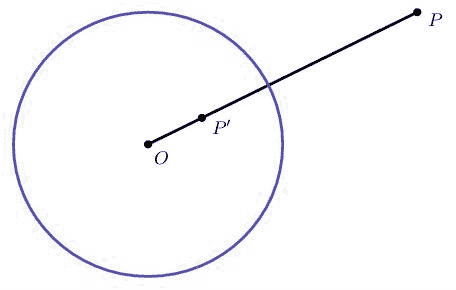
Remembering that we consider lines to be circles with zero curvature, we are able to say that inversion in a circle carries one circle into another circle. However, inversion does not preserve the Euclidean notion of distance so that the radii of a circle and its image under the inversion are usually not the same. Notice that inverting in the same circle twice returns a point to its original position.
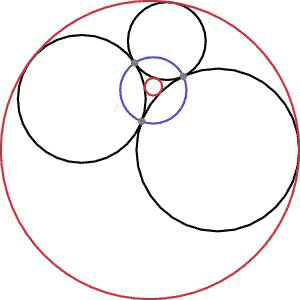
Now suppose we have a Descartes configuration on which we wish to perform a swap. If we focus our attention on the three circles that do not change, we may draw a circle through the three points of tangency. Inversion in this circle carries these three circles into themselves but swaps the fourth circle in the original Descartes configuration with the fourth circle in the new configuration. This gives a geometric realization of the swap operation. In the figure below, inverting in the blue circle interchanges the two red circles.
Apollonian circle packings
We now have a way to produce plenty of Descartes configurations. In particular, given a Descartes configuration, we may replace any of the four circles in the configuration in the manner described above. This leads to four new circles and four new configurations.
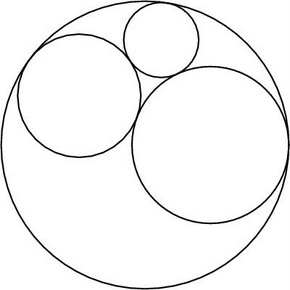
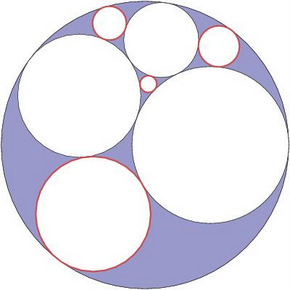
Of course, there is nothing to say that we can't repeat this process. We have four new configurations and we may perform three swaps on each of them (the fourth swap would return us to the original configuration).
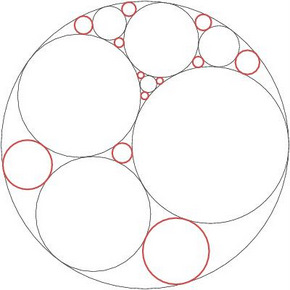
And again:

and again:
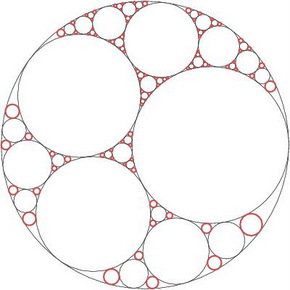
Continuing indefinitely, we find this:
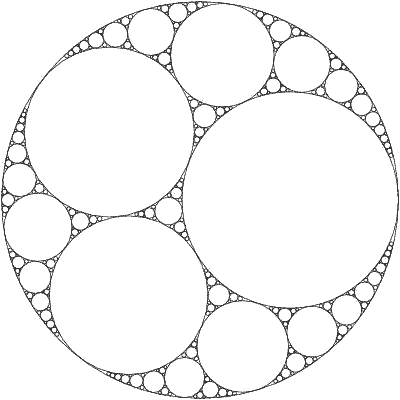
This is called an Apollonian packing in honor of Apollonius of Perga (circa 262-190 B.C.), sometimes called "The Great Geometer." Apollonius is perhaps best known for his treatise Conics, which studied ellipses, parabolas and hyperbolas as the intersections of planes with a cone. He also wrote Tangencies, which, though lost to us now, was reported to solve problems of constructing circles with various prescribed tangency conditions.
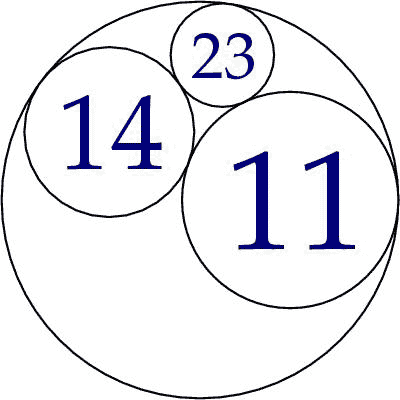
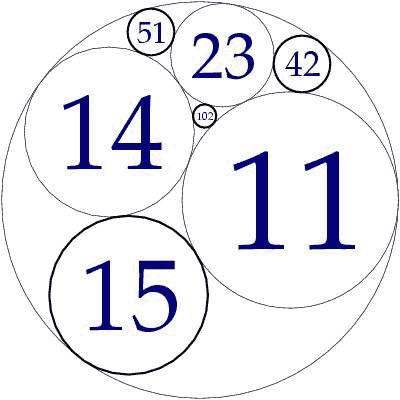
If we keep track of the curvatures in the Apollonian packing, we see the following, where the curvature of the outer circle is -6:
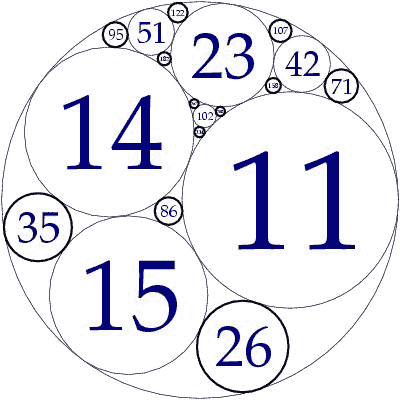
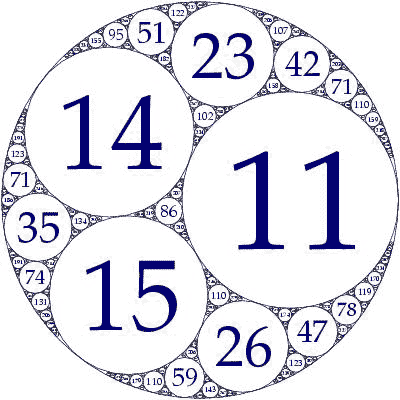
Starting with other configurations leads to the Apollonian packings:
 |
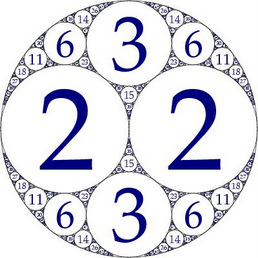 |
| (0, 0, 1, 1) |
(-1, 2, 2, 3) |
 |
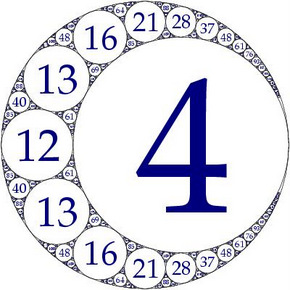 |
| (-3, 5, 8, 8) |
(-3, 4, 12, 13) |
These last four packings clearly exhibit a symmetry: reflecting the packing in a horizontal line leaves the packing unchanged. If we enlarge our notion of symmetry to include inversions in circles, this symmetry is just the tip of the iceberg. Earlier we saw that swapping one configuration for another may be accomplished by inversion in a circle. A moment's thought, however, will convince you that these inversions are symmetries of the entire packing. For instance, if we invert in the circle shown below, the packing will be carried into itself.
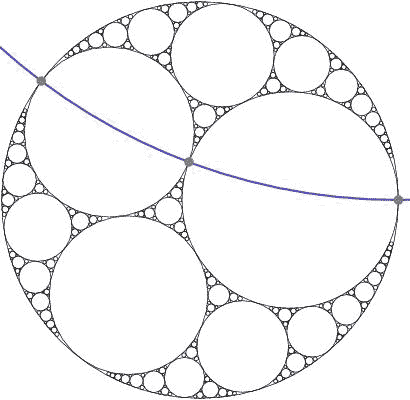
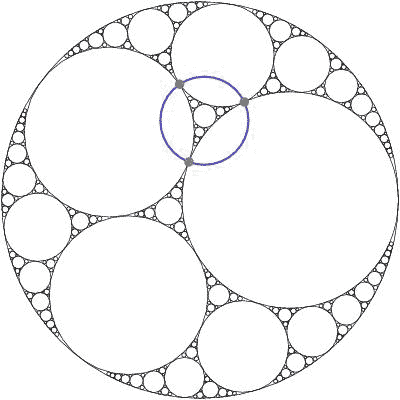
In fact, there is a multitude of such symmetries, one for each swap of one configuration for another. For example, inversion in the circle shown below has the effect of turning the packing inside out.
Strongly integral Apollonian packings
Apollonian packings in which the curvatures of all the circles are integers are called integral packings. We have seen above that a packing is integral if one of its Descartes configurations consists of four circles having integral curvatures.
Recent work by Ronald Graham, Jeffrey Lagarias, Colin Mallows, Allan Wilks, and Catherine Yan has shown that more is true. First, if we consider the centers of the circles as complex numbers  , the Descartes circle theorem has a remarkable extension found by Lagarias, Mallows, and Wilks:
![\[ (b_1z_1)^2+(b_2z_2)^2+(b_3z_3)^2+(b_4z_4)^2 = \frac12 (b_1z_1+b_2z_2+b_3z_3+b_4z_4)^2 \]](/featurecolumn/images/march2006/index_29.gif)
That is, the relationship expressed in the Descartes circle theorem still holds if we replace the curvature by the curvature times the center of the circle. In the same way as before, we see that when we perform our basic swap operation on configurations
![\[ b_4'z_4'=2b_1z_1+2b_2z_2+2b_3z_3-b_4z_4 \]](/featurecolumn/images/march2006/index_30.gif)
Among other things, this relationship simplifies drawing Apollonian packings--once we draw the initial Descartes configuration, the curvatures of subsequent circles are easily found from Descartes' original relationship, while the centers are found from its extension. This is considerably more simple than finding the new circle through inversion as described above.
It also follows that if the coordinates of the curvature times the center are integral for every circle in one configuration, then they are in the new configuration, and hence every other configuration in the packing, as well. We call a packing strongly integral if the curvature times the center has integral coordinates for every circle.
Graham et al have shown that
If we have an integral packing, then there is a Euclidean motion (such as, a reflection, rotation or translation) that moves it to a strongly integral packing.
Therefore, we may assume that the curvature times the center of every circle has integral coordinates. In particular, the centers of the circles have rational coordinates.
Enumerating integral packings
We have seen some illustrations of integral packings above. It seems natural to ask if we can create a list of all integral packings. Of course, if we are given one, we may produce another simply by rescaling the plane by a factor of, say, one-half. This would have the effect of multiplying all the curvatures by two. We will therefore restrict our attention to primitive packings in which the curvatures in any Descartes configuration have no common divisors.
The basic swap operation on configurations may be easily described algebraically by representing a Descartes configuration as a four-tuple  that we call the Descartes quadruple associated to the configuration. Swapping, say, the third circle in the configuration to form a new configuration may be described using matrix multiplication:
![\[ \left[\begin{array}{c} b_1 \\ b_2 \\ b_3' \\ b_4 \end{array} \right] = \left[\begin{array}{cccc} 1 & 0 & 0 & 0 \\ 0 & 1 & 0 & 0 \\ 2 & 2 & -1 & 2 \\ 0 & 0 & 0 & 1 \end{array} \right] \cdot \left[\begin{array}{c} b_1 \\ b_2 \\ b_3 \\ b_4 \end{array} \right] \]](/featurecolumn/images/march2006/index_32.gif)
We call this matrix  ; there are clearly analogous matrices
  ,
,  , and
, and  . The set of all products of the matrices
  is called the Apollonian group; it is related to the group of symmetries introduced above through inversion in circles and whose elements permute the configurations in a packing. The point is that the Apollonian group provides us with a way to move around in a packing from one configuration to another.
Graham et al have shown that every packing has one special quadruple, called the root quadruple, that may be used effectively to label the packing. (The labels under the packings shown above are their root quadruples.) The root quadruple consists of the curvatures of the largest circles in the packing, and there is an algorithm that uses the Apollonian group to produce the root quadruple given any other quadruple in the packing.
Graham et al show how to produce root quadruples using a change of variables:
![\[ \begin{array}{cl} a = & x \\ b = & d_1-x\\ c = & d_2-x \\ d = & -2m+d_1+d_2-x \end{array} \]](/featurecolumn/images/march2006/index_38.gif)
In these new variables, the condition that  defines a Descartes quadruple may be expressed more simply as
![\[ x^2+m^2=d_1d_2. \]](/featurecolumn/images/march2006/index_40.gif)
It turns out that  is a root quadruple exactly when
  . Moreover, since we are considering only primitive packings, we also require that
  and
and  have no common factors.
This gives a way to find root quadruples and hence integral Apollonian packings. For instance, if we wish to look for integral Apollonian packings in which the curvature of the outer circle is  where
where  is a non-negative integer, we need to find solutions
  where
where  and
and  .
.
As an example, if  , we need to find
  where
where  have no common factors,
  and
and  . A little experimentation shows that the only possibility is
  ,
,  , and
, and  . This produces the only root quadruple
  with
with  , and hence the only integral Apollonian packing whose bounding circle has curvature -2.
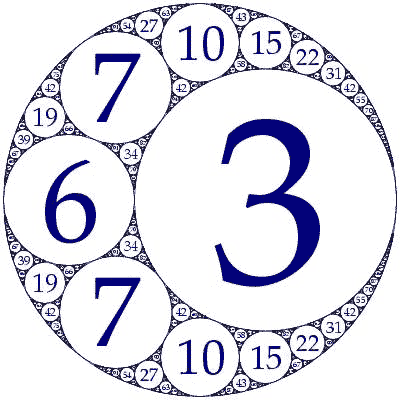
(-2,3,6,7)
Graham et al give a precise statement for the number of root quadruples with  for all
  .
.
References
R. Descartes, Oeuvres de Descartes, Correspondance IV, (C. Adam and P. Tannery, Eds.), Paris: Leopold Cert 1901.
T. Gosset, The Kiss Precise (Generalized) , Nature 139 (1937), 62. (See also http://pballew.net/soddy.html.)
R.L. Graham, J.C. Lagarias, C.L. Mallows, A. Wilks, and C. Yan, Apollonian circle packings: number theory, Journal of Number Theory, 100 (2003), 1-45. Available at http://www.arxiv.org/abs/math?papernum=009113.
R.L. Graham, J.C. Lagarias, C.L. Mallows, A. Wilks, and C. Yan, Apollonian circle packings: geometry and group theory I. The Apollonian group, Available at http://www.arxiv.org/abs/math?papernum=0010298.
R.L. Graham, J.C. Lagarias, C.L. Mallows, A. Wilks, and C. Yan, Apollonian circle packings: geometry and group theory II. Super-Apollonian group and integral packings. Available at http://www.arxiv.org/abs/math?papernum=0010302.
R.L. Graham, J.C. Lagarias, C.L. Mallows, A. Wilks, and C. Yan, Apollonian circle packings: geometry and group theory III. Higher dimensions. Available at http://www.arxiv.org/abs/math?papernum=0010324.
J.C. Lagarias, C.L. Mallows, and A. Wilks, Beyond the Descartes Circle Theorem, American Mathematical Monthly, 109 (2002), 338-361. Available at http://www.arxiv.org/abs/math?papernum=0101066.
D. Mumford, C. Series, and D. Wright, Indra's Pearls: The Vision of Felix Klein, Cambridge University Press, 2002.
F. Soddy, The Kiss Precise, Nature 137 (1936), 1021. (See also http://pballew.net/soddy.html.)
F. Soddy, The bowl of integers and the Hexlet, Nature 139 (1937), 77-79.
T. Rothman, Japanese Temple Geometry, Scientific American, May 1998, 84-91.
J.B. Wilker, Four proofs of a generalization of the Descartes circle theorem, American Mathematical Monthly, 76 (1969), 278-282.
David Austin
Grand Valley State University
david at merganser.math.gvsu.edu
NOTE: Those who can access JSTOR can find some of the papers mentioned above there. For those with access, the American Mathematical Society's MathSciNet can be used to get additional bibliographic information and reviews of some these materials. Some of the items above can be accessed via the ACM Portal, which also provides bibliographic services.