2. Fairness and Apportionment
The Constitution does not specify what fairness criteria should be used in comparing two different proposed ways to solve an apportionment problem. From the beginning there were both political and equity considerations in choosing an apportionment system but there are some principles that one can call attention to in evaluating apportionment systems. One fairness idea is that each state should get either its lower quota or upper quota. A second approach to fairness is to look at pairwise equity between states. The empirically discovered Alabama paradox (one can get fewer seats in a larger house, with fixed population) called to the attention of politicians and others interested in apportionment that one had to worry about the fairness properties of the methods that one might use to solve the apportionment problem. However, little seems to have been done in a systematic way to see what the consequences for fairness were of adopting different apportionments. In the United States, what became a matter of concern was the perception that different methods of apportionment might display bias. The idea of bias is that a method might systematically reward states with specific characteristics or groups of such states. For example, were some methods more likely to give smaller states more than their fair share of seats, say, as measured by exact quota? One way to try to answer this question was to turn to statistics. It is not hard to see that the different methods of apportionment treat small and large states in different ways. This can be seen in contrived artificial examples as well as using data that has arisen from the censuses. However, there are many different ways of thinking and models for deciding what constitutes bias of an apportionment method. As just one example, the Constitution itself has a bias in favor of small states because it will give every state one seat regardless of how undeserving the state might be. In computing bias of a method, how should this "minimum of one seat" condition be taken into account?
Huntington was a pioneer in using mathematical ideas to compare the different apportionment from a fairness point of view. His writings have an attractive conversational style, though like many good debaters he does not shy from leaving out things that do not help his case. Huntington realized that there were two major approaches to evaluating fairness:
1. Global optimization
This approach sets up a measure of fairness and for a given apportionment method sums up this measure for all the states. The goal is to select that method which minimizes the sum for the given measure over all the states. This approach involves various discrete optimization techniques and has not been pursued vigorously until relatively recently. Some of the optimization problems that one is led to may be computationally very difficult. Huntington rejects such methods but they are mathematically interesting nonetheless.
2. Pairwise comparison for states.
This approach involves making sure that switching a seat from one state to another does not diminish the fairness of the apportionment as given by some measure of fairness. Huntington championed the study of this way of approaching the apportionment problem. He showed, rather surprisingly, that each of the historic methods was best under at least one fairness measure. This created the troublesome situation that one had to make a value judgment as to which of these fairness criteria was the best in order to justify the choice of a particular method, and it is not clear on mathematical grounds how to do this.
First, Huntington observed that for each measure of equity between states one could look at this measure in absolute terms or in relative terms. Here is an example illustrating this, taken from one of Huntington's papers using data from the 1940 census: Using all of the census data, it turns out that Webster assigned Michigan (population 5,256,106) 18 seats and Huntington-Hill assigned it 17 seats, while Webster assigned Arkansas (population 1,949,387) 6 seats and Huntington-Hill assigned Arkansas 7 seats. The two methods agree except for the number of seats that they give to these two states. With these numbers, the size of the congressional district for Michigan under Webster was 292,006, while the size under Huntington-Hill was 309,183. The equivalent figures for Arkansas were 324,898 (Webster) and 278,484 (Huntington-Hill). Thus, the absolute difference between the two states for Webster was 32,892 (324,898-292,006). The absolute difference between the two states for Huntington-Hill was 30,699. By this measure Huntington-Hill did a better job. However, there is also the perspective of the size of the difference relative to the size of the populations of the states involved. Michigan is a much bigger state than Arkansas. In relative terms the Webster method resulted in a relative difference of 11.26 percent, while Huntington-Hill resulted in a relative difference of 11.02 percent. The relative difference for u and v is given by |u-v|/(min (u, v)). This example should not mislead one into thinking that Huntington-Hill always does a better job. Measuring the absolute difference in representatives per person would be the basis for defending why the Webster apportionment is better. I use this example only to illustrate the distinction between relative and absolute difference ideas.
Here is a summary of what Huntington discovered:
a. For relative differences, Huntington-Hill is the optimal method for all the fairness measures about to be listed. Recall that ai and Pi are the number of seats for state i and its population, respectively. For a fixed divisor method, the formula can be used to compare whether or not giving the next seat to state i or state j is more justified, as measured by the the given fairness formula.
b. For the measure  Adams method is optimal.
For the measure  Dean's method is optimal.
For the measure 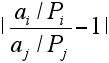 Huntington-Hill is optimal.
For the measure  Webster is optimal.
For the measure  Jefferson's method is optimal.
Again, it might not be obvious that these seemingly similar measures of absolute pairwise fairness would give rise to such different methods to achieve optimality. Yet Huntington showed that if one is concerned with relative differences, all the criteria formulas are optimal only for Huntington-Hill.
-
Apportionment Systems
-
Fairness and Apportionment
-
Balinski and Young's Contribution
-
Where to Next?
-
References
Welcome to the
Feature Column!
These web essays are designed for those who have already discovered the joys of mathematics as well as for those who may be uncomfortable with mathematics.
Read more . . .
Feature Column at a glance