Topology and Verb Classes
Feature Column Archive
7. Derivatives of the swallowtail: ``She repulses his advances,'' etc.
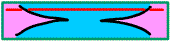
The swallowtail catastrophe has two derivative catastrophes, one of which is syntactically interesting. If we slide a two-dimensional piece of surface across one of the cusp lines of the locus, the point of tangency will spawn one or the other of the catastrophes that Thom calls the lips and beak-to-beak, according as the tangency is on the outside (the surface curls into the blue region) or on the inside (the surface curls into the pink region). The additional parameter corresponding to the sliding across the cusp line stabilizes these catastrophes: small perturbations of the motion will not affect the topology.
 |
| The beak-to-beakand lips catastrophes are exhibited at the point of tangency ofcurved pieces of surface with the cusp locus of the swallowtail.Embedding them in a one-parameter family (the surface sweepsacross the locus) stabilizes them. The green-edged piece is concave inward; at the beginning of the sweep (left to right) it is entirely in thepink (two-minimum) region. Then its intersection with the pinkregion narrows to one central stripe, then two touching beaks, at the point of tangency, and then two facingbeaks. The blue-edged piece isconcave outward; during the sweep (right to left)its intersecton with the pink region goes from empty to one point (at tangency)to the lips configuration. |
The beak to beak catastrophe has two one-dimensional sections with syntactic interpretations.
Welcome to the
Feature Column!
These web essays are designed for those who have already discovered the joys of mathematics as well as for those who may be uncomfortable with mathematics.
Read more . . .
Feature Column at a glance