

| 436 files in 31 albums with 0 comments viewed 416,412 times |
|
Robert J. Lang :: Origami
|

|


|
|
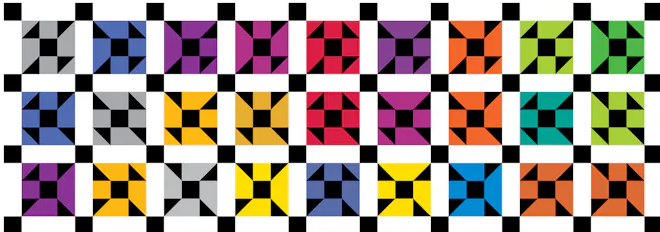
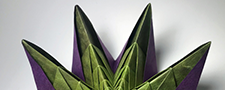
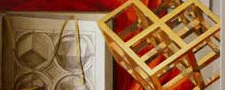
The intersections between origami, mathematics, and science occur at many levels and include many fields of the latter. We can group these intersections into roughly three categories: Origami mathematics, which includes the mathematics that describes the underlying laws of origami; Computational origami, which comprises algorithms and theory devoted to the solution of origami problems by mathematical means; Origami technology, which is the application of origami (and folding in general) to the solution of problems arising in engineering, industrial design, and technology in general. One genre blends into another. Origami math defines the "ground rules" for computational origami's goal of solving origami design problems (and quantifying their difficulty). The results of computational origami, in turn, can be (and have been) pressed into service to solve technological problems ranging from consumer products to the space program. Origami, like music, also permits both composition and performance as expressions of the art. Over the past 40 years, I have developed nearly 600 original origami compositions. About a quarter of these have been published with folding instructions, which, in origami, serve the same purpose that a musical score does: it provides a guide to the performer (in origami, the folder) while allowing the performer to express his or her own personality website includes galleries of my designs, crease patterns, schedule of my lectures, appearances and exhibitions, commissioned works, and more on the science of origami.
--- Robert J. Lang
17 files, last one added on May 22, 2013 Album viewed 1230 times
|
|
|
2013 Mathematical Art Exhibition
|

|


|
|
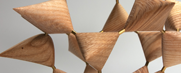
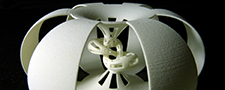
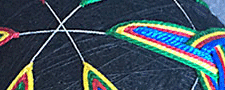
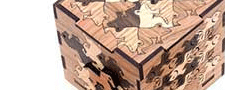
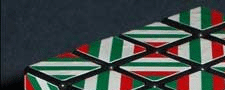
The 2013 Mathematical Art Exhibition was held at the Joint Mathematical Meetings held in San Diego, CA. Here on Mathematical Imagery is a selection of the works in various media. Mathematical Art Exhibition Awards were given: "Bended Circle Limit III," by Vladimir Bulatov was awarded Best photograph, painting, or print; "Inlaid Wooden Boxes of Makoto Nakamura's Tessellations," by Kevin Lee was awarded Best textile, sculpture, or other medium; and "Tessellation Evolution," a beaded necklace by Susan Goldstine received Honorable Mention. The Award "for aesthetically pleasing works that combine mathematics and art" was established in 2008 through an endowment provided to the American Mathematical Society by an anonymous donor who wishes to acknowledge those whose works demonstrate the beauty and elegance of mathematics expressed in a visual art form. The thumbnail images in the album are presented in alphabetical order by artist last name.
27 files, last one added on May 16, 2013 Album viewed 410 times
|
|
|
|
|
|
|
|
|
|
|
|
|
|
|
|
|
|
|
|
|
2009 Mathematical Art Exhibition
|

|


|
|
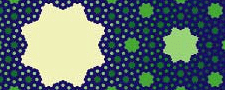
The Mathematical Art Exhibition held at the 2009 Joint Mathematics Meetings in Washington, DC, included 49 works in various media by 36 artists. Robert Fathauer was the curator of the exhibition, and the exhibition website was prepared by Anne Burns. The exhibition was juried by Fathauer and Burns, along with Nat Friedman and Reza Sarhangi. The inaugural Mathematical Art Exhibition Prizes were awarded. Four judges, selected by the American Mathematical Society and the Mathematical Association of America, made the following awards: First Prize to Goran Konjevod, for his origami work, "Wave (32), 2006;" Second Prize to Carlo Séquin, for his sculpture, "Figure-8 Knot, 2007;" and Third Prize to Robert Fathauer, for "Twice Iterated Knot No. 1, 2008." The Prize "for aesthetically pleasing works that combine mathematics and art" was established in 2008 through an endowment provided to the American Mathematical Society by an anonymous donor who wishes to acknowledge those whose works demonstrate the beauty and elegance of mathematics expressed in a visual art form. The thumbnail images in the album are presented in alphabetical order by artist last name.
49 files, last one added on Apr 28, 2009 Album viewed 4603 times
|
|
|
|
|
Gwen L. Fisher :: Woven Beads
|

|


|
|
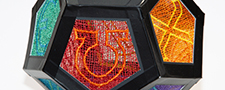
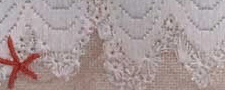
Weavers of beads use a needle and thread to sew beads together to make decorative objects including jewelry, wall hangings, sculptures, and baskets. Some bead weave designers weave beads into composite clusters, usually with at least one large hole, called beaded beads. Mathematically, many beaded beads can be viewed as polyhedra, with each bead (or, more precisely, the hole through the middle of each bead, which provides its orientation) corresponding to an edge of the polyhedron. Different weaving patterns will bring different numbers of these "edges" together to form the vertices of the polyhedron. So it is very natural to use various polyhedra as the inspiration for beaded bead designs. Mathematics, including geometry, symmetry, and topology, is an inspiration for the structure of these woven bead creations. Across cultures and continents, humans show a natural affinity towards the aesthetic of pattern and order, and this art form appeals to this aesthetic in a tactile, tangible form. --- Gwen L. Fisher, Ph.D., California Polytechnic State
University, San Luis Obispo, and beAd Infinitum (www.beadinfinitum.com)
9 files, last one added on Aug 26, 2011 Album viewed 850 times
|
|
|
|
|
|
|
|
|
Jean-Francois Colonna :: A Gateway Between Art and Science
|

|


|
|
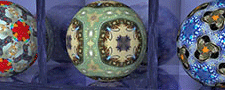
Mathematics plays a very particular role in the quest for knowledge. Whether mathematicians are involved in invention or discovery, the tools that they develop have constituted the very basis of science for more than 2000 years. Mathematics, which has been considered for too long as a mere language in which to formulate the laws of nature, is now recognized as a creative thought process that can be used to discover new entities and phenomena.
Yet scientific knowledge is undoubtedly not the only way of comprehending the infinite wealth of phenomena in our universe. Art, the quest for beauty and the indefinable, is another way forward, a means of progress that is parallel to the means provided by science, and we surmise that still more possibilities exist, probably more than we could ever imagine.
---Jean-Francois Colonna, Centre de Mathematiques Appliquees, Ecole Polytechnique, www.lactamme.polytechnique.fr
6 files, last one added on Jun 20, 2008 Album viewed 862 times
|
|
|
|
|
Nathan Selikoff :: Algorithmic Artwork
|

|


|
|
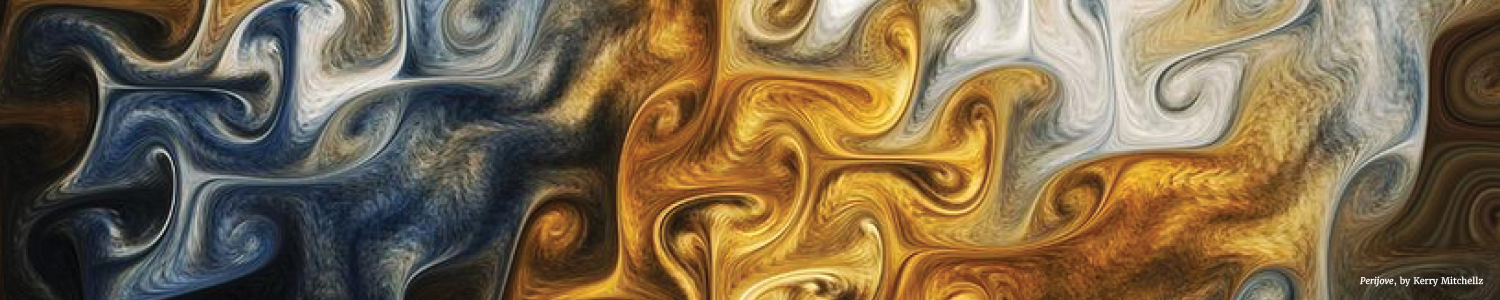
I love experimenting in the fuzzy overlap between art, mathematics, and programming. The computer is my canvas, and this is algorithmic artwork--a partnership mediated not by the brush or pencil but by the shared language of software. Seeking to extract and visualize the beauty that I glimpse beneath the surface of equations, I create custom interactive programs and use them to explore algorithms, and ultimately to generate artwork.
In the world of chaotic dynamical systems, minute changes in initial conditions produce radically different results. The interface of my software gives me hooks into the algorithms and allows me to exert some control. But there is always tension - between the computer and me, between simplicity and complexity, and between problem solving and spontaneity.
Art and mathematics, the right brain and the left, are inextricably linked in this work. My art depends on mathematics, yet simultaneously illuminates and unravels its beauty. I am an explorer who uncovers something extraordinary, bringing into view that which was always there to be discovered.
---Nathan Selikoff
6 files, last one added on Jul 23, 2010 Album viewed 921 times
|
|
|
|

|