

Selected Highlights of the Joint Mathematics Meetings, January 2001
New Orleans provided a festive backdrop for the Joint Mathematics Meetings, which were held January 10-13, 2001 and which drew close to 5,000 participants. Those who attended the meetings will recall some of these events, and those who were not able to attend can sense here the variety of experiences that the annual meetings offer. We invite you to come to next year's Joint Mathematics Meetings in San Diego, Ca, January 6-9!

Measuring the Universe
Playing tic-tac-toe could provide insight into the universe, or so claims Jeffrey Weeks, freelance mathematician and winner of the MacArthur "genius award." At the Joint Mathematics Meetings, Weeks presented an AMS-MAA Joint Invited Address entitled "Measuring the Universe." This one-hour talk, based on his book, The Shape of Space, delved into several fundamental questions about the universe. Is it expanding, contracting, or static? Is it flat, hyperbolic, or spherical? Is it infinite? Or are we seeing multiple copies of a finite space? Weeks presented evidence for a flat, expanding universe, but couldn't answer the last question. What he finds most fascinating, should the universe prove to be finite, is how the copies glue together. Will we discover we live in a torus? Or in a Klein bottle?
And that's where tic-tac-toe comes in. To explore the torus and Klein-bottle topologies, Weeks created online children's games like tic-tac-toe and crossword puzzles, with edges identified, like a torus or a Klein bottle. For instance, for a crossword 5 letters wide, "ustor" could spell "torus" on the torus. Solving the puzzles takes some shift in perspective--imagine how a Klein bottle could tangle even the simplest maze. If you'd like to test your topological talent, visit Weeks' web site.
Will we ever know if we live in a torus? According to Weeks, if our universe is finite and sufficiently large, data from NASA's MAP expedition in April 2001 and European Space Agency's Planck satellite, to be launched a few years later, could provide conclusive answers. Otherwise, it could be lifetimes before the matter is settled.
-- Kathryn Leonard, Brown University, AAAS-AMS Media Fellow (2000)
Who Wants to be a Mathematician
"Is that your final answer?" asks the gentleman in the dark suit and metallic tie. "Final answer," is the reply. Are we on the set of a popular TV show? No, we're at the Joint Mathematics Meetings watching high school students solve challenging algebra and logic questions in the AMS spin-off, Who Wants to be a Mathematician? Ten contestants qualified to be in the contest by earning the highest scores on a written math test administered prior to the meetings.
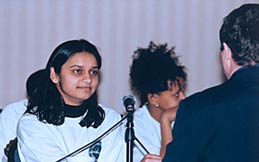 |
After being evaluated in a "fastest finger" round, four of the ten contestants earned a turn in the hot seat. By far, Suhitha Reddy's round provided the most excitement. Breezing through even the most challenging questions, Suhitha, a student at Academy of the Sacred Heart, met her match only two questions away from the grand prize. |
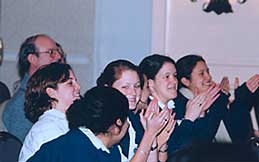 |
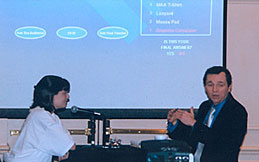
Armed with the "50/50" and "Ask the Audience" lifelines, Suhitha chose to ask the audience---a wise decision, considering most of the onlookers were professional mathematicians. Though clearly preferring the correct answer, the audience split! After a few agonizing moments, Suhitha selected her answer---the wrong answer. With one lifeline left, Suhitha walked off the stage with a subscription to The College Mathematics Journalinstead of $2000. |
 |
Other winners were Jessica Ordoyne of Archbishop Blenck High School, who won a subscription to The College Mathematics Journal, Alex Fink of Archbishop Shaw High School, and Zack Angelo of the New Orleans Center for Science and Math, each of whom won an AMS T-shirt. Other contestants were Johvanna Dabney of the New Orleans Center for Science and Math, Perry Poussard and Brandon Fontanelle of Archbishop Shaw, and Devon Magee, Kassey Marie Gethers and Rebecca Cola of McDonogh 35 High School.
Prizes ranged from a "graphite calculator" to $2000 and were donated by AMS, MAA, Maple, Texas Instruments, and Brooks/Cole Publishing. And, the ABC-affiliate TV station covered the event on the 6:00 local news! |
Launching a Career in Mathematics
If you've proven the Riemann Hypothesis in your thesis, read no further. You'll have no trouble finding a job after graduate school. For the rest of us, the panel discussion "Launching a Career in Mathematics" offered sound advice on everything from beginning the job search to negotiating a contract. The panel was sponsored by the Association for Women in Mathematics, and the panelists were Carolyn Gordon of Dartmouth College, Tasha Innis of Trinity College in Washington, DC, Tamara Kolda of Sandia National Laboratory, and Lisa Mantini of Oklahoma State University.
How to begin? Start early. Go to conferences during your graduate studies, introduce yourself to people in your area, and follow up with an email. Do everything possible to maximize the number of people who will know your name when you apply for jobs. If you plan to work in industry, try to spend a summer working outside academia. If you are looking for an academic job, remember that most application deadlines are in late fall or early winter, and plan accordingly. Writing a CV, teaching statement, research statement, and cover letter at the last minute will not be pleasant.
Once you've earned an interview, be sure to know the big picture of your field and where your contribution fits into it. Promote yourself! An interview is no time for humility or apology. Speak confidently about your work and your future plans.
Making the transition from student to professional is not always easy. Finding a research mentor may help, so look for one at seminars, conferences, or through hearsay. Areas for future research often appear in questions about your work, so write down any questions you can't immediately answer. Devote time during your postdoctoral appointments to continue networking. Write conference organizers directly to request to speak at their events. Submit articles to journals a few levels higher than where you think they'll be accepted. And above all, don't let a few disappointments affect your confidence in your work.
If all goes well, you'll eventually need to negotiate a contract for a permanent position. The moment before you accept the job is your moment of greatest power, so ask for everything you want---nicely, of course. Ask for a window, a computer, a nice chair, and a reduced teaching load for a semester a year or two down the line. Find out all you can about salaries at the institution---for public schools this data is in the library---and make sure your salary is competitive for salaries in the coming year, not the current year. And, of course, get everything in writing.
Good luck!
--- Kathryn Leonard, Brown, University, AAAS-AMS Media Fellow (2000)
Giving Your First Talk
There you are, sitting in the front row of a Special Session, pretending to listen to the person giving the talk that precedes your talk, while you frantically review the notes you have already gone over 150 times. Then the organizer speaks those dreadful words that you are never prepared for: "Our next speaker will be in 3 minutes". As you begin to get your transparencies ready, you glance up and catch the eye of the mathematician who wrote the very first book on your research area. Your heart begins to beat a bit faster as you scan the rest of the audience. The familiar faces of your advisor and colleagues are somewhat pacifying, until you are introduced into the spotlight. Giving your first talk at a Joint Mathematics Meeting can be a bit nerve-wracking. You may get some intimidating questions from someone in the audience who seems to know a bit more than you. However, the fact of the matter is that you are the expert here, and this is your moment. As soon as you finish your last transparency, you begin to mentally jump for joy, until the organizer says, "Any questions?". You are still on such a high that the first question sounds like gibberish. So you smoothly evade it by saying, "No, I have not tried that technique, but maybe we could talk about it later." No matter what transpires, there is nothing quite like the feeling of having conquered your first presentation to a room full of professional mathematicians from all over the country, and perhaps all over the world.
--- Mary Ann Saadi, University of Rhode Island, AAAS-AMS Media Fellow (2000)
Mathematics and Art
Did you know that the recycling symbol is a Möbius strip or that Salvador Dali's "Crucifixion" contains an unfolded hypercube? If you had attended the Invited Address "A Kaleidoscope of Mathematics and Art," you would have seen many such connections between mathematics and artistic creations from all over the world. Given by Ivars Peterson, a reporter for Science News, the slide presentation displayed tetrahedron sculptures in New Orleans, Möbius strips on the Mall in Washington D.C., and the barcode for p in the tiling of the Toronto subway. So the next time someone tries to tell you that he or she is an artist, not a mathematician, you can say "What's the difference?"
--- Mary Ann Saadi, University of Rhode Island, AAAS-AMS Media Fellow (2000)
Math leads accomplished scholar down a rabbit hole
This was the headline of an article the Times-Picayune published about Robin Wilson and his special presentation The Mathematics of Lewis Carroll.
"On Thursday night in New Orleans, [Wilson] and a small cast performed before a standing-room only crowd of about 600 delegates to the joint meeting of five math organizations. He and his fellow amateur thespians, who portrayed a mixture of characters from the Alice books and people the Victorian-era author would have known, won a standing ovation after they led the audience through about 75 minutes of math, Alice, mock turtles, symbolic logic and Cheshire cats. Wilson said the mathematical foundations are evident in the Alice books— people know where to look." John Pope, a science staff writer for the Times-Picayune, interviewed Wilson for over an hour on the day of the performance, and his article clearly showed an appreciation of Wilson’s enthusiasm, sense of humor, and knowledge about Dodgson’s life and works. "[Wilson] can discourse about Dodgson’s book Pillow Problems, which consists of math problems Dodgson devised at bedtime and solved in his head, and he can rattle off Oxford sites that Carroll used in the Alice books."
The full article ran in the January 13 edition of the Times-Picayune newspaper.
--- Annette Emerson, AMS Public Awareness Officer
Talks by Eleanor Robson and Todd Mateer are covered in Science News
Ivars Peterson of Science News wrote articles about two talks at the Meetings. One article concerns the talk given by Eleanor Robson of Oxford University regarding a clay tablet from Mesopotamia knows as Plimpton 322. Although the tablet contains mathematical symbols, its exact purpose is unknown. Robson presented evidence that the tablet is a teacher's guide for creating homework problems. Peterson's second article is about a talk given by Todd Mateer, a recent graduate of Clemson University, on strategies for video poker. According to Mateer, South Carolina's limit on machine payouts means your best strategy is not to play. Both articles are on page 56 of the January 27 issue of Science News.
-- Mike Breen, AMS Public Awareness Officer
Jobseekers Optimistic at Employment Center
One feature of the Joint Mathematics Meetings is the Employment Center (formerly known as the Employment Register), which assists jobseekers and employers in scheduling interviews during the meetings. For much of the 1990s, when young mathematicians faced a constrained and competitive job market, the Employment Center was the site of much angst and uncertainty. But in the last two or three years, thanks mostly to an increase in the number of open positions, prospects are brighter for job applicants. Consider this: At the 1996 Employment Center, there were around 50 employers offering positions and about 500 jobseekers, while this year there were about 150 employers and 340 jobseekers. The most recent Annual Survey shows that the number of open positions in mathematics increased from about 1100 to about 1500 between 1994 and 1999. Employers participating in the New Orleans Employment Center seem more satisfied too. Although there were reports of worries over declines in numbers of applications, most employers were glad to find they are receiving fewer unsuitable applications from panicky jobseekers blanketing the market. Also, the World Wide Web has helped the job search process by making available plenty of information about colleges and universities, so that applicants can make more informed choices about where to apply. Generally jobseekers at the New Orleans Employment Center seemed to believe that the job market had improved markedly in the last few years. But, as one jobseeker put it, "I'll believe it when I get a job that I want."
--- Allyn Jackson, Senior Writer and Deputy Editor, Notices of the AMS
Bonnie Berger and Monica Hurdal Talks are Reported in the Media
Science magazine reported on a computer program called BetaWrap, developed by Bonnie Berger, Lenore Cohen and Phil Bradley of MIT's mathematics department. The program helps to understand how proteins work and to predict parts of their structure much faster. 'The work is "a tremendous accomplishment," says Peter Kim, a protein biologist... 'The bottom line is that a computer scientist has drawn attention to a class of proteins involved in human disease, which are potentially of medical significance."' Berger's announcement of the results was made at the Joint Mathematics Meetings in New Orleans, and the article, 'Virtual Molecules Nail Bacteria's Weapon', appeared in the February 2, 2001 issue of Science (page 809). The Economist ('Navigating your mind', January 25, 2001) reported on Monica Hurdal's presentation of her work on "quasi-conformal maps of the human brain from circle packings." The article, subtitled "a 19th-century mathematical technique is making it possible to map the details of people's brains", also appeared in the European publication Trouw.
--- Annette Emerson, AMS Public Awareness Officer
AMS honors William L. Duren, Jr. for his 71 years of membership!
 |
William Duren received special acknowledgement and thanks at this year’s AMS Banquet for his 71 years of AMS membership. His son Peter (also a mathematician), colleagues old and new, and AMS President, Executive Director and staff saluted Bill for his longevity of membership. At the end of the banquet old friends and well-wishers surrounded him to offer warm greetings, recollections of the past, and congratulations on his contributions and accomplishments over the years.
He wasn't asked to respond publicly to this "highest |
All agree that it was great to see Bill Duren at the 2001 Joint Mathematics Meetings and at the annual AMS Banquet!
[William Duren majored in mathematics at Tulane, and received his Ph.D. at the University of Chicago (where he met and married Mary Hardesty). They returned to New Orleans in 1931, where he joined the Tulane faculty; he became Chair of the Math Department in 1948, and established the Ph.D. program there. In 1952 he became the first program director for mathematics in the NSF, and remained active in national efforts to reform the curriculum in mathematics. In 1955 he moved to the University of Virginia as Dean of the College of Arts and Sciences, serving concurrently as the President of the MAA. He helped to form a new Department of Applied Mathematics and Computer Science in the Engineering School, where he taught until his retirement in 1975. You can read his "Memoirs of a Lay Mathematician" in A Century of Mathematical Meetings, edited by Bettye Anne Case (AMS, Providence, RI, 1996).]
--- Annette Emerson, AMS Public Awareness Officer